The lens that throws a small flame twenty miles
A first-order lens stands eight feet tall and bends one lamp into a flat beam. How the steps work, what the orders mean, and what really caps the range.
What the steps are for
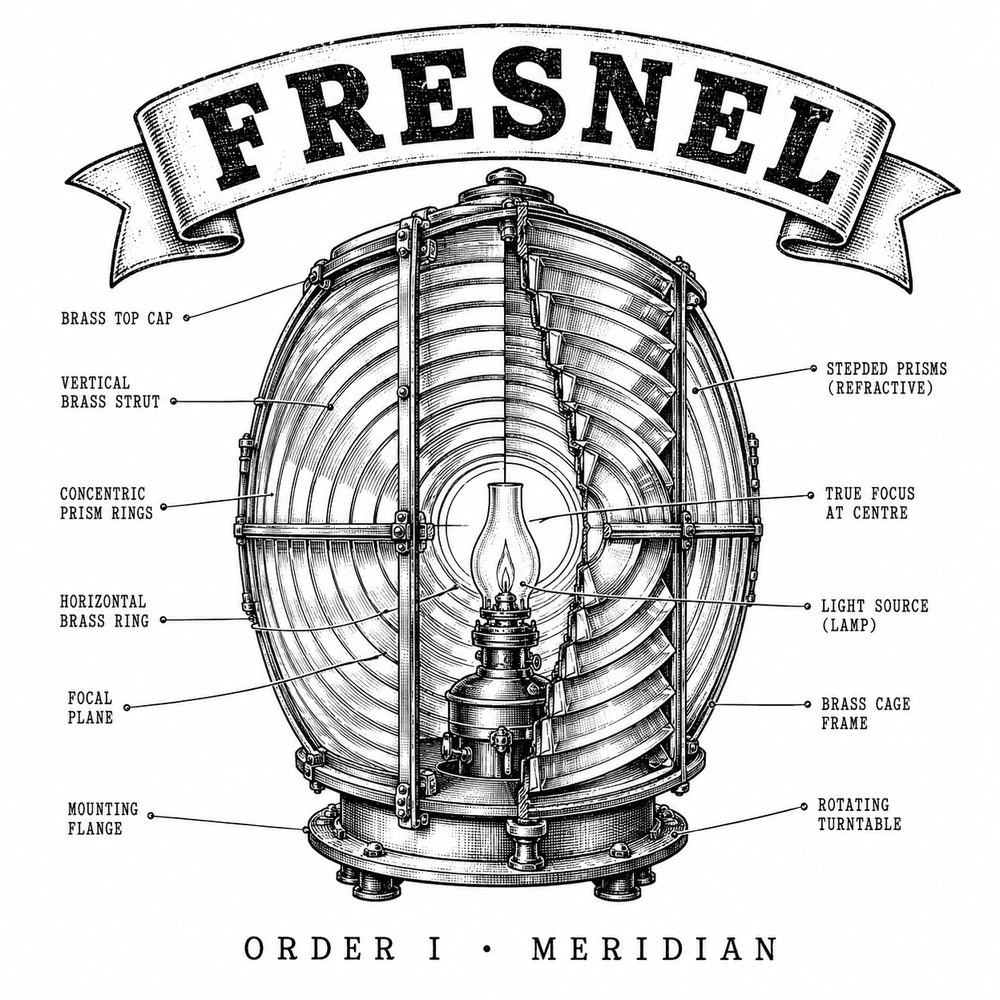
A lens bends light at its two surfaces. Everything in between is glass whose only job is to hold those surfaces at the right distance from each other. Augustin-Jean Fresnel’s proposal was to remove the middle: keep the curvature, discard the bulk behind it, and set what remains in concentric rings around one common focus.
The National Park Service describes the result as a lens “much thinner than a conventional lens, using prisms to refract light to the center of the lens, where it is concentrated into a powerful beam.” A lamp at the focal point leaves the far side not as a spreading glow but as concentrated parallel beams — light that would have gone up into the sky or down onto the rocks is turned and sent at the horizon instead.
The idea was not new when Fresnel began the work in June 1819. Buffon and Condorcet had each proposed stepped lenses before him, and neither was built: nobody could grind a single piece of glass to Buffon’s design, or make Condorcet’s rings in one piece. Fresnel’s contribution was a version that could be manufactured in pieces and assembled in a frame.
It went to sea at Cordouan in July 1823 — an octagonal drum of eight stepped lenses, a ring of metal mirrors at the base throwing the lowest rays seaward, eight small lenses above aimed at the horizon, and at the centre a lamp with five wicks. Before that, lighthouses reflected their light with mirrors, which the Park Service puts at a best visibility of eight to twelve miles.
An order is a measurement, not a grade
First-order, sixth-order: these sound like rankings and they are not. The order of a Fresnel lens is defined by its focal distance — the distance from the focal point out to the inner surface of the glass. Every other dimension follows from that one number.
A first-order lens has a focal distance of 920 millimetres, stands 101.97 inches tall and weighs 12,787 pounds. A sixth-order lens has a focal distance of 150 millimetres, stands 17.05 inches, and weighs between 65 and 220 pounds. Same instrument, same principle, separated by a factor of roughly sixty in mass.
The size chosen was a statement about the water rather than the budget. First-order lenses went on seacoast landfall lights, where a ship’s first sight of land had to arrive from as far out as the earth would allow. Sixth-order lenses went on harbour entrances and pier heads, where the job was to mark one specific edge to somebody already close to it. 467 first-order lenses were built, and 635 sixth-order.
Refract, reflect, refract
The belt at the middle of the lens — the bull’s-eye — handles light that is already close to horizontal, and bends it once. That is the easy part. The difficulty is the light leaving the lamp steeply upward and steeply downward, which is most of it.
Two kinds of ring deal with that. Dioptric prisms, sitting inboard, catch low-angle light and bend it a single time. Catadioptric prisms, the outermost rings above and below, work on the steepest rays and act on them more than once. The Park Service diagram for the Point Reyes lens labels the three zones in exactly those terms.
This is why a first-order lens is a barrel and not a disc. The tall rings above and below the belt are not structure and not decoration. They are the parts of the lens that reclaim the light a mirror would have thrown away.
Twenty miles is a claim about the earth, not the lamp
Lighthouse ranges get quoted with great confidence, so it is worth being exact about what they measure. The Coast Guard’s Light List keeps three separate definitions, and they answer three different questions.
Nominal range is the greatest distance a light can be seen in clear weather, where clear is defined as meteorological visibility of ten nautical miles. Luminous range adjusts that for the weather actually present. Geographic range is different in kind: “the greatest distance the curvature of the earth permits an object of a given height to be seen from a particular height of eye without regard to luminous intensity or visibility conditions.”
That third figure is a ceiling nothing on the tower can raise. A light with a focal plane 150 feet above the sea has a geographic range of 14.3 nautical miles; at 250 feet it is 18.5. To that you add the observer’s own horizon — 4.5 nautical miles from a height of eye of fifteen feet.
Which is why the published numbers only add up in pairs. Fire Island’s first-order light, lit on 1 November 1858 with a focal plane 166 feet above sea level, is documented as visible to ships at least 21 nautical miles out. The tower does not reach that by itself. It reaches it with a lookout standing some thirty feet above the water — which, on a ship of that period, is exactly where a lookout stood. A range is a statement about a light and a person together, and it quietly stops being true if you drop either one.
Six thousand pounds, started with one finger
A fixed light marks a coast. A flashing one tells you which coast — and to flash, the whole assembly has to turn. The Point Reyes lens is 24 vertical panels of 42 prisms and a bull’s-eye apiece: 1,032 individually cast pieces of glass, six thousand pounds of them, rotating once every two minutes to lay a flash on the horizon every five seconds.
It was driven by a falling 175-pound weight, which a keeper rewound every two hours and twenty minutes, all night, every night, from the day it was lit on 1 December 1870.
Fresnel proposed floating the assembly on a bath of mercury in 1825. It took until 1890 for Léon Bourdelles to make the idea work, first installed at Cap de la Hève in 1893 and in the United States at Ashtabula Harbor in 1915. The effect was immediate and slightly absurd: the weight needed to start a lens turning fell from 200 pounds to 75. Several tons of glass, floated, could be set moving with a single finger.
Sources
- The Fresnel Lens — National Park Service
- Thomas Tag, “The Fresnel Lens” — United States Lighthouse Society
- Fresnel Lens Orders, Sizes and Weights — United States Lighthouse Society
- The Historic Point Reyes Lighthouse — National Park Service
- Light List Volume III, 2024 — US Coast Guard Navigation Center
- Fresnel Lens History, Fire Island Light — National Park Service
- Thomas Tag, “Lens Rotation” — United States Lighthouse Society
- Cordouan’s first lens — Ministère de la Culture, France
- Point Reyes Lighthouse restoration — National Park Service
The plate
Fresnel
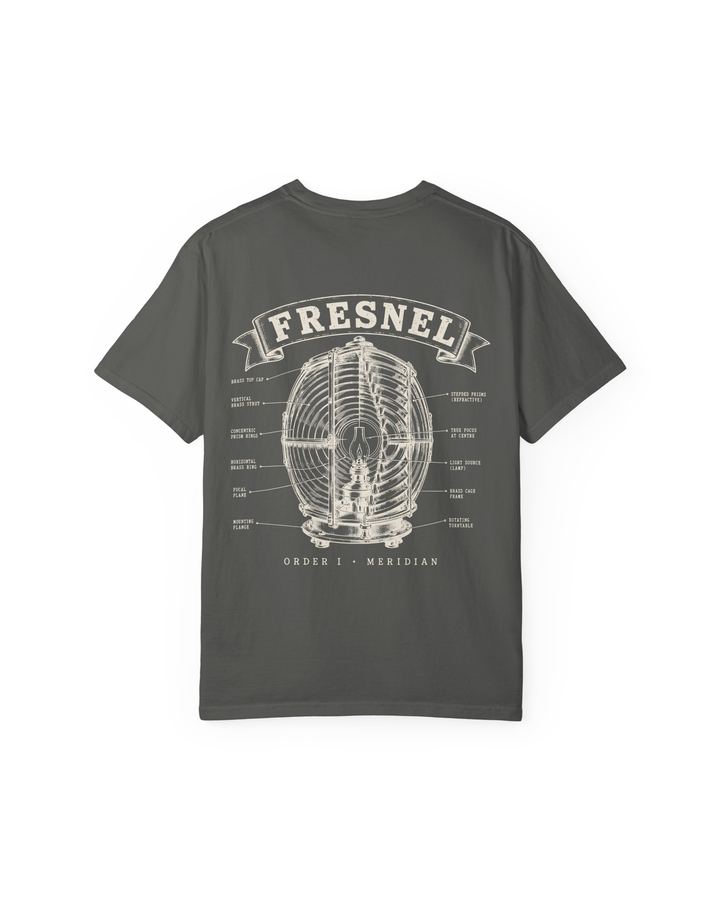
A first-order lighthouse lens in cutaway: concentric glass steps that bend a single flame into twenty miles of open sea.
See the plate — $48