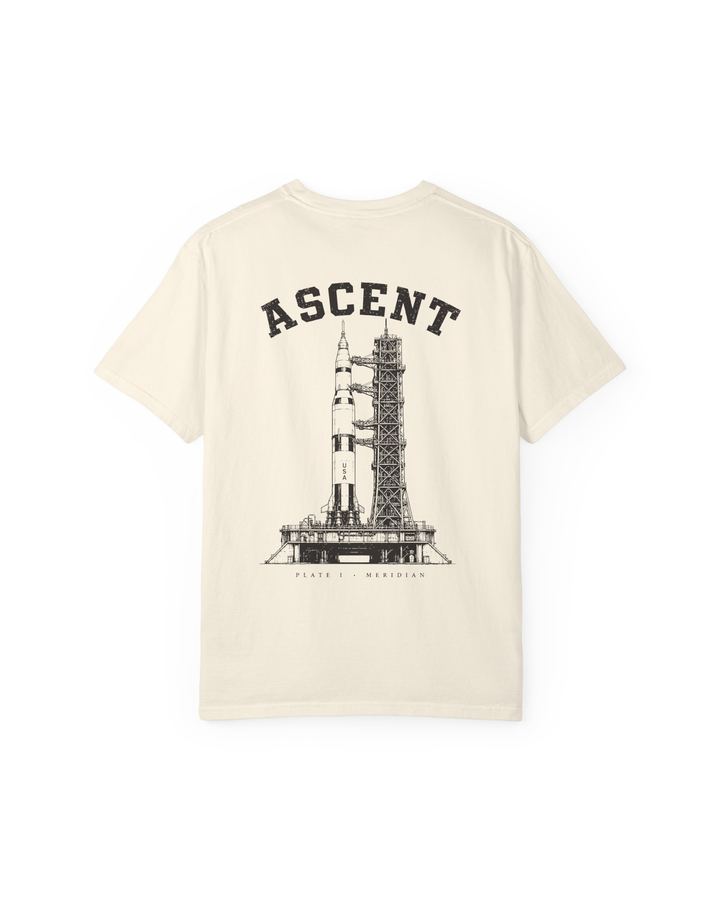
The tower that lets go
A service tower holds a fuelled rocket upright, feeds it, chills it, then lets go of every connection in under a second. The last thing to touch it.
Nine arms, and the last of them lets go at first motion
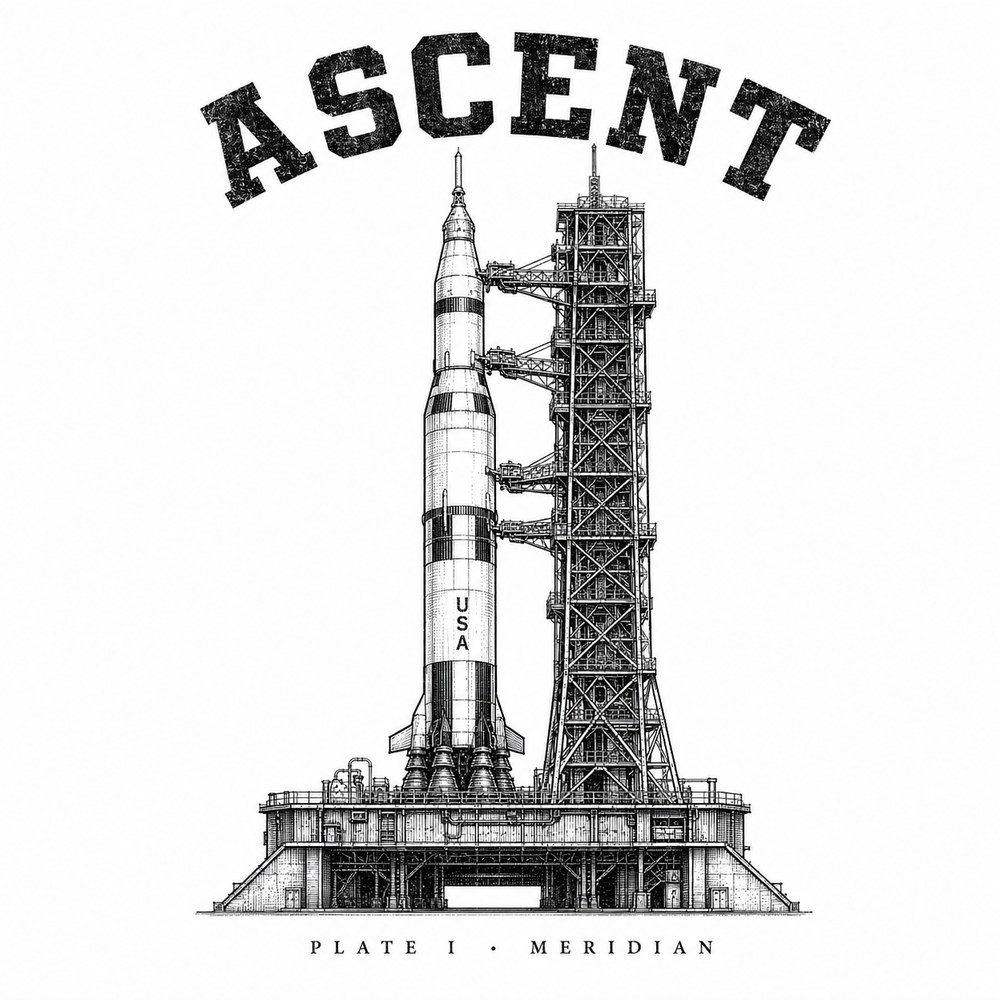
A rocket on the pad is not a self-contained object. It is a structure being held upright, fed, chilled, purged, monitored and powered by something else, and the something else is a tower. The Saturn V’s Launch Umbilical Tower carried nine service arms, three tail service masts at deck level, and four holddown arms — every one of which had to be gone, or about to be gone, at the moment of release.
The arms divided into two kinds, and the distinction is the interesting one. Preflight arms retracted and locked before liftoff on a schedule: the S-IC forward arm swung away at T−16.2 seconds and was locked by T−11.0. The crew access arm at the 320-foot level moved to a 12-degree park position 43 minutes before launch — close enough to swing back for an escape — and retracted fully at T−5 minutes.
Inflight arms did not retract on a clock. They stayed connected to a fuelled, running rocket and were unlocked at T−15 seconds, then pulled off by the vehicle itself. The umbilical carriers were pushed clear pneumatically once the vehicle had risen three quarters of an inch. Their retract times, once released, ran from 6 seconds for the S-IC forward arm to 9 seconds for the service module arm — slow, in the circumstances, which is why nothing was allowed to depend on them being fast.
What is worth reading in the flight manual is the escalation. If the pneumatic push failed, a secondary mechanical release acted at about two inches of rise. If that failed, the carrier was simply caromed off the vehicle at around fifteen inches. At eighteen inches, the system stopped waiting for a retract signal that was evidently not coming and bypassed the switch. Four answers to the same question, each one cruder than the last, because by then the rocket is leaving whether the tower has finished or not.
It has to keep feeding the thing until the last minutes
The reason the tower cannot simply be disconnected an hour early is that cryogenic propellant does not sit still. Liquid oxygen is loaded at about −183 °C and liquid hydrogen below −253 °C, and both are boiling in the tank from the moment they arrive. Every minute on the pad, some fraction leaves as gas and has to be replaced.
So the tower tops the vehicle up continuously. On the Saturn V, S-IC liquid oxygen was replenished at up to 500 gallons per minute — nearly 1,900 litres — and hydrogen at up to 480. NASA’s own wording in the flight manual is undramatic about it: “Propellants are being replenished as required to supplement cryogens lost due to boiloff. Boiloff will continue until the various stage vent valves are closed for tank prepressurization.” That closure comes at T−3 minutes 06 seconds. Until then the rocket is drinking.
The scale of the supporting infrastructure follows from that. Pad storage for Apollo held 900,000 gallons of liquid oxygen and 850,000 of liquid hydrogen, with oxygen pumped to the vehicle at up to 10,000 gallons per minute. The LC-39 hydrogen tanks hold 3,220,000 litres each behind vacuum-jacketed perlite insulation, and still lose an average of 1,200 to 2,700 litres a day to nothing but heat leaking in.
The number that reframes the whole enterprise is this: across Kennedy and Stennis, roughly half of all the liquid hydrogen ever purchased is lost before it can be burned — 12.6 per cent to replenishment, 12.2 per cent to evaporation in storage, the rest to chilldown, bleeds and venting. The tower is not a convenience. It is the visible part of a system whose job is to lose the fuel slightly more slowly than it is being delivered.
Four arms, fifty milliseconds
Underneath all of that, the vehicle is being physically held down. The Saturn V sat on four holddown arms, each preloaded to 700,000 pounds — 3.11 meganewtons — and each weighing over twenty tonnes on its own. The engines lit, came up to thrust, and were checked while the arms held the rocket against them.
Then the arms had to let go, and they had to let go together. The specification is that the unlatching interval across all four must not exceed 0.050 seconds. Fifty milliseconds. Release the arms unevenly and you apply a lateral moment to a fully fuelled vehicle at the exact instant it stops being restrained.
The mechanism is pneumatic: high-pressure helium drives a separator. Bench testing put that at about 20 milliseconds at 750 psi with helium, against roughly 69 with gaseous nitrogen. And if a separator has not operated within 0.180 seconds, the system does not wait or retry — an explosive nut link is detonated and the arm is released by destroying it.
The last detail is the one that best explains the mindset. Letting go instantly would slam the load into the vehicle, so release is deliberately slowed by a controlled release mechanism: a tapered pin drawn through a die over the first 15.2 centimetres of travel, with the restraining force decaying linearly from 75,000 pounds to zero. Sixteen were provided; eight were normally used on lunar missions. The rocket is not released so much as handed over.
What goes wrong is almost always the hydrogen
The failure history of these interfaces is remarkably consistent, and it is not about structures. It is about sealing a joint against the smallest molecule there is, at −253 °C, in a fitting that must then come apart cleanly.
The launch commit criterion for gaseous hydrogen at the Shuttle’s ground umbilical carrier plate was 40,000 parts per million — four per cent, which is hydrogen’s lower flammability limit. On 11 March 2009, STS-119 hit a calculated 61,000 ppm during topping. STS-127 did the same in June, then 41,700 ppm on its second attempt three days later. For context, the worst previously recorded in-specification case across 31 loadings was 13,500 ppm.
The root cause, when it was finally run down after another leak in November 2010, was a concentricity tolerance stack-up: the carrier plate offset by 0.049 inches, shifting to 0.061 under load, against a probe offset of 0.024. The fix was to shave one pivot foot by 0.100 inches, shim the other by 0.025, and replace the one-piece flight seal with a two-piece design. Afterwards, leakage measured about 50 ppm — the detection floor.
It has not gone away. On 3 September 2022 the Artemis I attempt was stopped by a hydrogen leak in the cavity between the ground-side and flight-side plates of a quick disconnect on the eight-inch liquid hydrogen line; engineers tried warming the disconnect to reseat it. On 2 February 2026, during the Artemis II wet dress rehearsal, hydrogen flow was stopped again when concentrations at the tail service mast umbilical interface exceeded limits. Sixty years of this, and the difficult part remains a face seal measured in thousandths of an inch.
And the water, which is not for the fire
The last thing the pad does before the vehicle leaves is drown itself. At Launch Complex 39B, a tower holds around 400,000 gallons; a test flowed roughly 450,000 in under thirty seconds, at a peak rate of about 1.1 million gallons per minute. The Apollo system had a million gallons of industrial water available, with 29 nozzles on the launcher deck running 50,000 gallons a minute for the first thirty seconds and flame trench nozzles starting ten seconds before liftoff.
The common assumption is that this is firefighting or cooling. It is neither. It is acoustics. Eight and a half million pounds of thrust converts a large fraction of its energy into sound, the trench reflects that energy back up at the vehicle, and the vehicle is a thin-walled structure full of instruments. The water is there to absorb sound before it reaches the payload.
Even the trench itself is harder to pin down than it should be. The Apollo-era documents give it as 58 feet wide, 450 feet long and about 42 feet high. NASA’s current Launch Complex 39B page gives the north side as about 571 feet long — and also says 450 feet, on the same page. We have printed both rather than pick one.
The modern equivalent of the Saturn tower is Mobile Launcher 1: 380 feet tall overall, a 40-foot-square tower, 662 steps, with umbilicals stacked up its height — tail service masts at 33 feet, the core stage intertank at 140, the forward skirt at 180, a vehicle stabiliser at 200, the upper stage at around 240, the crew access arm at 274 and the Orion service module umbilical at 280. Eight cast-steel support posts, five feet tall and about 10,000 pounds each, carry the vehicle through T-0. Its total mass is variously given by NASA as 10.5, 11.3 and 11.5 million pounds, depending which of its own publications you read.
One more thing, offered as an anecdote rather than a fact, because we could not find it in a NASA-authored document: a fuelled cryogenic stage is widely reported to physically shrink when loaded — the SLS core stage tank contracting several inches in length under 537,000 gallons of liquid hydrogen. The load figures are on NASA’s fact sheet. The contraction is not, so we are not printing a number for it.
Sources
- Saturn V Flight Manual SA-507 (MSFC-MAN-507) — NASA Marshall Space Flight Center
- Apollo 11 Press Kit — NASA, 26 June 1969
- Phillips & Tolson, “Holddown Arm Release Mechanism Used on Saturn Vehicles” — NASA KSC (NTRS 19760012107)
- Notardonato et al., “Zero Boil-Off Methods for Large Scale Liquid Hydrogen Tanks” — NASA (NTRS 20170006481)
- United Space Alliance, “GUCA GH2 Leak Investigation White Paper” — NASA Lessons Learned
- Engineers Troubleshooting Liquid Hydrogen Leak — NASA Artemis blog, 3 September 2022
- Artemis II Wet Dress Rehearsal: Teams Stop Flow of Core Stage Liquid Hydrogen — NASA, 2 February 2026
- Launch Complex 39B — NASA reference page
- Water Deluge Test a Success at Launch Pad 39B — NASA
- Mobile Launcher Tower: Umbilicals and Accessories (FS-2021-08-727-KSC) — NASA Facts
- Mobile Launcher 1 — NASA Exploration Ground Systems
- Crawler-Transporters — NASA Facts
- Space Launch System Core Stage fact sheet — NASA
The plate
Ascent
A launch vehicle and its service tower, drawn the way an engineer would have drawn it in 1967 — outline, crosshatch, no romance.
See the plate — $48