Why a radio dish has to be enormous
Resolution scales with wavelength over diameter, and radio waves are vastly longer than light. The arithmetic that forces a hundred-metre mirror.
The constant everyone quotes is the wrong one
Every account of telescope resolution starts in the same place: the smallest angle you can resolve is about 1.22 times the wavelength divided by the aperture. The constant is not arbitrary. It comes from the first zero of the Bessel function J₁, which sits at 3.8317; divide that by π and you get 1.2197. It is the radius of the dark ring around a point source in a perfect circular lens, and it is the whole of the Rayleigh criterion.
It is also not the number radio astronomers use. Condon and Ransom’s Essential Radio Astronomy — the NRAO’s own textbook — gives the half-power beamwidth of a uniformly illuminated circular aperture as 0.89 λ/D, and for the tapered illumination that real dishes actually have, about 1.2 λ/D. These are different quantities from the Rayleigh figure: one is the distance to the first null, the others are the width of the beam at half its peak power. They get conflated constantly.
The honest way to settle it is to stop deriving and go and measure. The Green Bank Telescope’s beam at 1420 MHz has been measured at 9.088 ± 0.009 arcminutes. Work backwards through its 100-metre aperture and the implied coefficient is 1.25 — close to the tapered 1.2, nowhere near 0.89. So the number this article uses is the measured one.
The reason to labour the point is that the constant is the least interesting term in the equation. Whether it is 0.89 or 1.25 changes the answer by forty per cent. What follows changes it by six orders of magnitude.
Nine arcminutes, which is worse than your eye
The most important frequency in radio astronomy is 1420.4 MHz — the hyperfine transition of neutral hydrogen, the 21-centimetre line, the thing that lets you map the gas that galaxies are made of. Visible light is around 500 nanometres. The ratio between them is about 422,000.
Put 21 centimetres through a 100-metre dish and the beam comes out roughly 9 arcminutes across. The Green Bank Telescope is the largest fully steerable object on land — 100 by 110 metres of reflector, 7,700 tonnes of structure that tracks the sky — and at the frequency it was largely built to observe, it resolves about a sixth of a degree. The full Moon would fit inside three of its beams.
Human visual acuity is around 1 arcminute. The largest steerable telescope ever built sees the radio sky roughly nine times more coarsely than you see this page.
The comparison that hurts more is Hubble: 2.4 metres of mirror at 500 nanometres gives about 0.05 arcseconds. To match that at 21 centimetres, the same arithmetic demands an aperture of roughly 1,013 kilometres. Not a bigger dish — a dish the length of California, steerable, and held to a fraction of a millimetre.
This is the predicament of radio astronomy in one line. It is not that radio telescopes are primitive. It is that they work with waves a few hundred thousand times longer than light, and geometry does not care how good the engineering is.
So build it bigger, and meet the two walls
The first wall is gravity. A dish that is a perfect paraboloid pointing at the zenith is not a perfect paraboloid pointing at the horizon; it is the same steel sagging in a different direction. Past a certain size the deformation exceeds the tolerance, and the obvious answer — build it stiffer — loses, because the stiffening weighs more and sags too.
The way out is a genuinely elegant piece of engineering called homologous design: instead of resisting the deformation, shape the backup structure so the deformed surface is still a paraboloid, merely a different one with its focus in a new place. Then move the receiver to follow it. The 100-metre Effelsberg telescope was the first deliberately homologous telescope, and the institute’s own documentation describes exactly that — deformations that “led always to a new paraboloid (with different focus position)”, with the feed repositioned under computer control.
The second wall is the surface itself. The Ruze equation gives the efficiency lost to surface error as exp[−(4πσ/λ)²], where σ is the RMS deviation from the ideal shape. It is brutally non-linear. The working rule in Essential Radio Astronomy is σ ≈ λ_min/16 — and at that tolerance you have already thrown away almost half the telescope, since exp[−(π/4)²] is about 0.54.
The rule predicts the hardware. Effelsberg holds its surface to roughly 0.55 mm; multiply by 16 and you get 8.8 mm, and Effelsberg works down to about 7 mm. The GBT is specified at 1.2 mm RMS at its 44-degree rigging angle, which by the same rule is good for around 19 mm — nothing like the millimetre wavelengths it is rated for. It gets there by refusing to accept the surface as built: 2,209 actuators behind the panels reshape it in real time, and holographic measurement has pulled it from 390 down to about 240 micrometres.
That is what size actually costs. Not steel — steel is cheap. It costs a surface held to a quarter of a millimetre across two acres, while tilting.
The fixed dishes cheat, and one of them fell
You can escape the tilting problem by refusing to tilt. Arecibo’s 305-metre reflector and FAST’s 500-metre reflector sit in natural hollows and do not move; the telescope is aimed by moving the receiver above the dish rather than the dish beneath the sky.
The cheat has a price that is rarely stated plainly. Neither instrument uses its full width at any one moment. FAST illuminates about 300 metres of its 500-metre surface at a time, dropping to around 200 at large zenith angles. Arecibo’s effective illuminated aperture was roughly 221 metres, not 305. The headline number is the civil engineering; the number that goes into the resolution equation is smaller.
Arecibo collapsed on 1 December 2020, when the remaining support cables failed and the instrument platform — some 900 tonnes of it — fell into the dish. The 2024 National Academies assessment concluded that the most likely initiating factor was long-term zinc creep in the cable spelter sockets, accelerated, in their reading, by the telescope’s own unusually intense electromagnetic environment. The structure was not brought down by a storm. It was brought down by a metal flowing slowly at room temperature for fifty-seven years.
The escape is to stop building one mirror
Resolution depends on the distance between the outermost parts of the aperture, and only on that. Which means you do not, strictly, need the middle. Two dishes 36 kilometres apart, their signals combined with the phase preserved, resolve like a 36-kilometre aperture.
The Very Large Array in its widest configuration has a maximum baseline of 36.4 km and reaches 1.3 arcseconds at 1.5 GHz — some four hundred times finer than a 100-metre dish at the same frequency. The VLBA stretches ten 25-metre antennas from Hawaii to the US Virgin Islands, a maximum baseline of 8,611 km, which at 21 centimetres works out to roughly 5 milliarcseconds. The Event Horizon Telescope took the idea to the size of the planet and published an angular resolution of 20 microarcseconds at 1.3 mm — enough to render the ring around M87*, measured at 42 ± 3 microarcseconds.
But interferometry does not hand you the telescope for free, and this is the part most accounts skip. A filled aperture buys two things at once: resolution, which grows with diameter, and collecting area, which grows with diameter squared. An array buys only the first. Its sensitivity is the sum of the areas of the antennas that are actually there, and nothing more.
The VLBA’s ten 25-metre dishes come to about 4,900 square metres — less collecting area than a single 100-metre dish — while resolving some two thousand times finer. That is the trade in one sentence: the array sees detail the big dish cannot approach, and the big dish catches signal the array will always miss. Which is why, seventy years into interferometry, we still build hundred-metre dishes.
One line worth not repeating
There is a famous claim that all the energy ever collected by all the radio telescopes in history amounts to less than a snowflake hitting the ground. It appears everywhere, usually attributed to Carl Sagan, sometimes with a chicken feather in place of the snowflake.
It originated with Frank Drake, was popularised by Sagan in Cosmos in 1980, and — as far as anyone who has gone looking has established, including by asking Drake directly — has no published calculation behind it. Drake reportedly suggested it might be two or three snowflakes by 2013.
It may well be true. It is not sourced, and the drifting variants are the signature of a story being retold rather than a figure being checked. Every other number on this page can be followed to a document. That one cannot, so it appears here as an anecdote and nowhere else.
Sources
- Condon & Ransom, “Essential Radio Astronomy”, Ch. 3: Radio Telescopes and Radiometers — NRAO
- Condon & Ransom, “Essential Radio Astronomy”, Ch. 1: Introduction — NRAO
- Boothroyd et al. (2011), “Accurate Galactic 21-cm H I measurements with the NRAO Green Bank Telescope” — Astronomy & Astrophysics
- Green Bank Telescope capabilities — NRAO Science
- Nikolic et al. (2011), “Holographic Measurement and Improvement of the Green Bank Telescope Surface”
- Effelsberg 100-m telescope, technical data — Max Planck Institute for Radio Astronomy
- Effelsberg antenna user guide, on homologous distortion — MPIfR
- Failure and Collapse of the Arecibo Observatory Telescope (2024) — National Academies
- VLA Observational Status Summary: Resolution — NRAO
- Introduction to the VLBA — NRAO
- EHT Collaboration (2019), “First M87 Event Horizon Telescope Results. I. The Shadow of the Supermassive Black Hole”
- Astronomers Capture First Image of a Black Hole — ESO release eso1907
- Bill Higgins, “The Snowflake and the Radio Telescopes” — on the provenance of the Drake/Sagan line
The plate
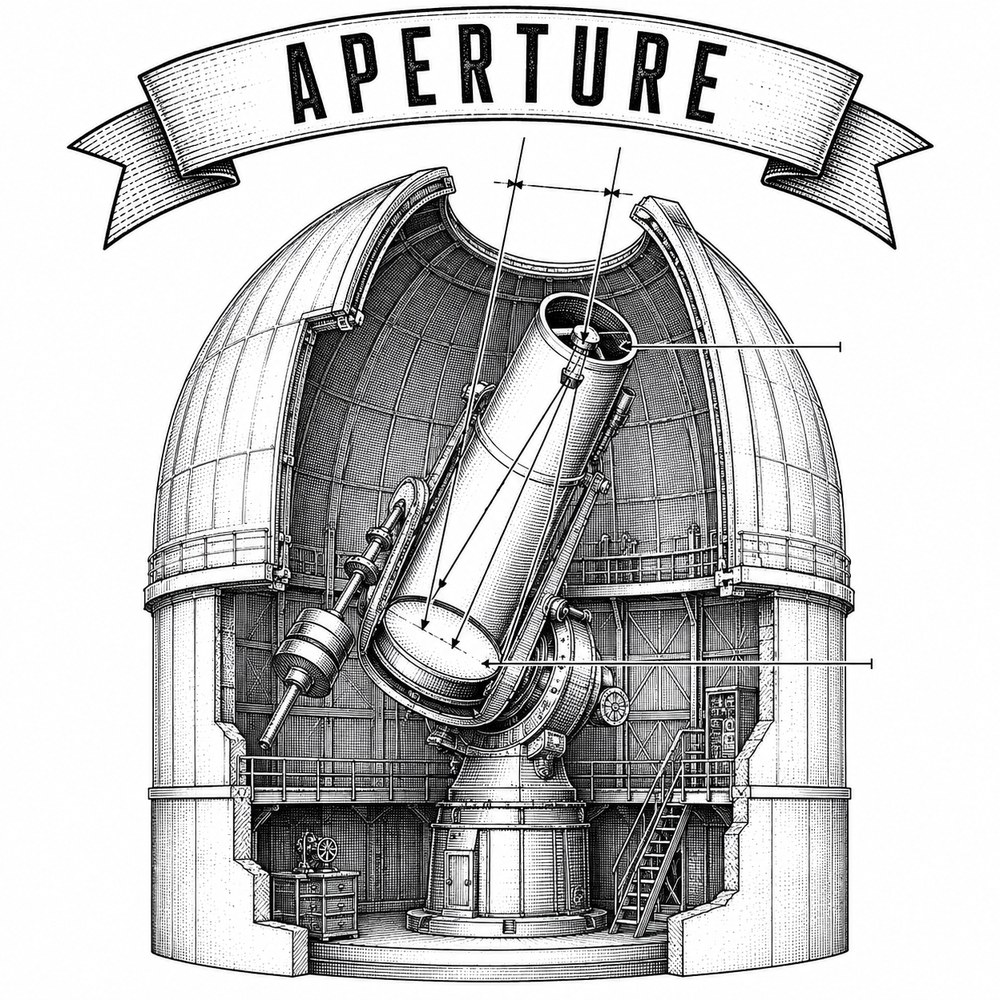
Aperture
A reflector in its dome, cut open along the optical path. Everything in the building exists to hold one mirror still.
See the plate — $48