One cable, no engine, 923 metres
The Bathysphere had no propulsion and no way home except the winch above it. What Beebe and Barton actually built, and why a sounding lead came first.
The line came first
Before anyone went down, the only way to learn the depth of the ocean was to lower a weight until it stopped. The Challenger expedition did this 492 times between 1872 and 1876, across 362 stations, using a Baillie sounding device — a weighted tube that took a bite of the bottom and shed its ballast so the line could be hauled back.
On 23 March 1875, near 11°24′N 143°16′E, Challenger’s line ran out to 4,475 fathoms: 26,850 feet, about 8,184 metres. They had found the deepest water on the planet with a rope and a lead. What they could not do was look at it.
The instruments got better. Lord Kelvin had a wireline sounding machine working by 1872, faster and more accurate than hemp rope, and NOAA credits Commander Sigsbee with the first truly operational piano-wire machine. But all of them answer the same one question — how deep — and return nothing else. A sounding is a number. It is not an observation.
A sphere with nothing to push against
The Bathysphere was designed by Otis Barton with the naval architects Cox & Stevens, and cast by the Watson-Stillman Hydraulic Machinery Company. William Beebe, then directing the Department of Tropical Research at the New York Zoological Society, supplied the expedition around it. The sphere was finished in the spring of 1930.
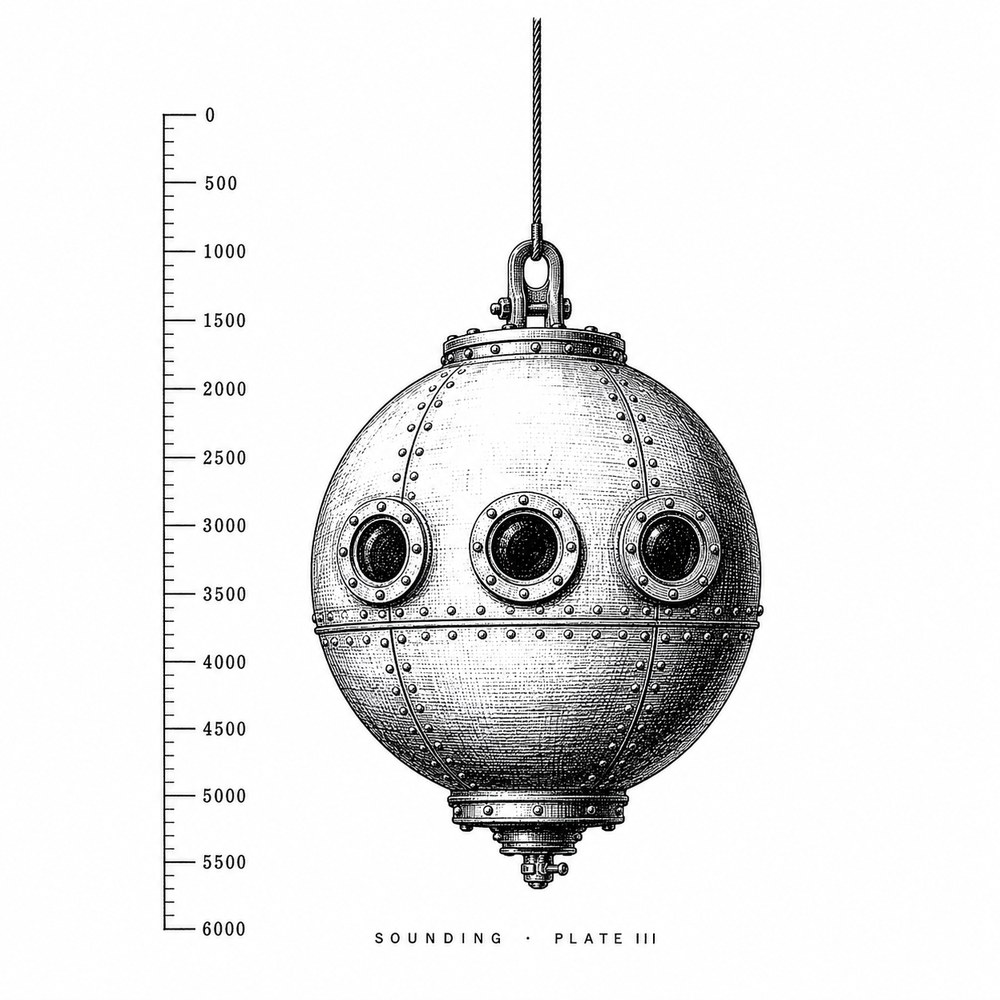
It is a single steel casting, specified as the finest grade of open-hearth steel: four feet nine inches across the outside, fifty-four inches across the inside, with walls between one and a quarter and one and a half inches thick. The first casting weighed five tons and was scrapped before it was ever used, because no winch in Bermuda could lift it. The replacement weighs about five thousand pounds — Beebe writes 5,400 in his narrative and his two collaborators write 5,000 in the appendices of the same book, which is a fair warning about how these figures travel.
There are three window turrets and only ever two windows; the third aperture was closed with a steel plug. The windows are cylinders of fused quartz, eight inches across and three inches thick, made by General Electric. Five were ground and three were lost before they got wet — one chipped, one burst under test at 1,250 pounds per square inch, one cracked because its bolts were tightened unevenly. The door weighs 400 pounds, closes with ten bolts over a fourteen-inch manhole, and is finished with a brass wing-bolt at the centre.
It had no engine. It could not steer, rise, or stop on its own. It hung on one non-spinning steel cable seven-eighths of an inch thick and 3,500 feet long, with a breaking strain of 29 tons, worked by a seven-ton winch on a chartered open-decked barge called Ready, driven by two boilers at 110 pounds of steam.
Beside the cable ran a separate rubber hose just over an inch in diameter carrying four conductors: two for light, two for the telephone. In 1930 it was fixed to the main cable every two hundred feet with double-jawed clamps. Later they threw the clamps away and used six-foot lengths of quarter-inch rope tied in clove hitches, for a single reason — rope can be cut. If the hose fouled during an ascent, a knife dealt with it without stopping the winch. The clamps would have meant stopping, and stopping is the one thing you cannot do with two men on the end of the cable.
Thirteenth of September, 1932
They sent it down empty. A spare quartz window had been fitted into the third aperture, and the sphere was lowered to three thousand feet with nobody inside.
It came back full of water, with compressed air trapped above it. Beebe began unscrewing the brass wing-bolt at the centre of the door. In his own account: “Suddenly, without the slightest warning, the bolt was torn from our hands, and the mass of heavy metal shot across the deck like a shell from a gun.” It hit the steel winch thirty feet away and sheared a half-inch notch out of it. Behind the bolt came what he called a solid cylinder of water. His conclusion: “If I had been in the way I would have been decapitated.”
The water inside stood at 56 degrees Fahrenheit, which told them the leak had started around two thousand feet down. The quartz window itself was undamaged. The packing around it had failed. They ran the test again days later with the steel plate refitted by hand, and it happened a second time with greater force — two new dents in the winch handles and a stream of water four inches across.
That is what they were riding into. No part of the design argued with the pressure. It only decided what held.
Three thousand and twenty-eight feet
Every dive was made inside an eight-mile circle centred about nine miles south-south-east of Nonsuch Island, Bermuda. On 6 June 1930 Beebe called a halt at 800 feet. Five days later they reached 1,426 feet — though the summary table at the back of the same book says 1,428.
On 15 August 1934 they went to 3,028 feet: 923 metres, a little over half a mile down, at a pressure of 1,360.3 pounds per square inch. That was the record.
Power came from a 1,500-watt generator on the barge at 110 volts, which arrived at the sphere as 72 to 76. The telephone ran on a 22.5-volt dry battery. The lighting circuit doubled as the emergency signalling system, because there was no third circuit to spare.
What he saw, and what was not accepted
At three thousand feet, Beebe wrote: “I looked out and watched an occasional passing light and for the first time I realized how completely lacking was the so-called phosphorescence with which we are familiar at the surface… Here each light is an individual thing, often under direct control of the owner. A gigantic fish could tear past the window, and if unillumined might never be seen.”
He identified lanternfish and dragonfish by the arrangement of their lights. He also named several new species from sight alone, through eight inches of quartz, with no specimen and no photograph. Carl Hubbs attacked exactly that in his 1935 review of the book, and the modern assessment agrees with him: a 2020 paper in the ICES Journal of Marine Science notes that none of the four species Beebe described from the window is recognised today.
The same paper makes the other half of the point, which is the half that usually gets left out — Hubbs went on to cite Beebe’s peer-reviewed work approvingly. The observations that failed were the ones that could not be checked by anyone else. It is the same distinction the sounding line was making all along: a number you can hand to someone, against a thing you saw and cannot.
Sources
- William Beebe, “Half Mile Down” (1934), with the Barton and Tee-Van technical appendices
- August 15, 1934: World-Record Dive in the Bathysphere — American Physical Society
- The Challenger Expedition — Woods Hole Oceanographic Institution, Dive & Discover
- The Challenger Deep — Cornell University Library, “Challenging the Deep”
- The Challenger Expedition 1872–1876 — Royal Museums Greenwich research guide
- Timeline: The Breakthrough Years 1866–1922 — NOAA Ocean Exploration
- Dolan (2020), “The neglected contributions of William Beebe” — ICES Journal of Marine Science
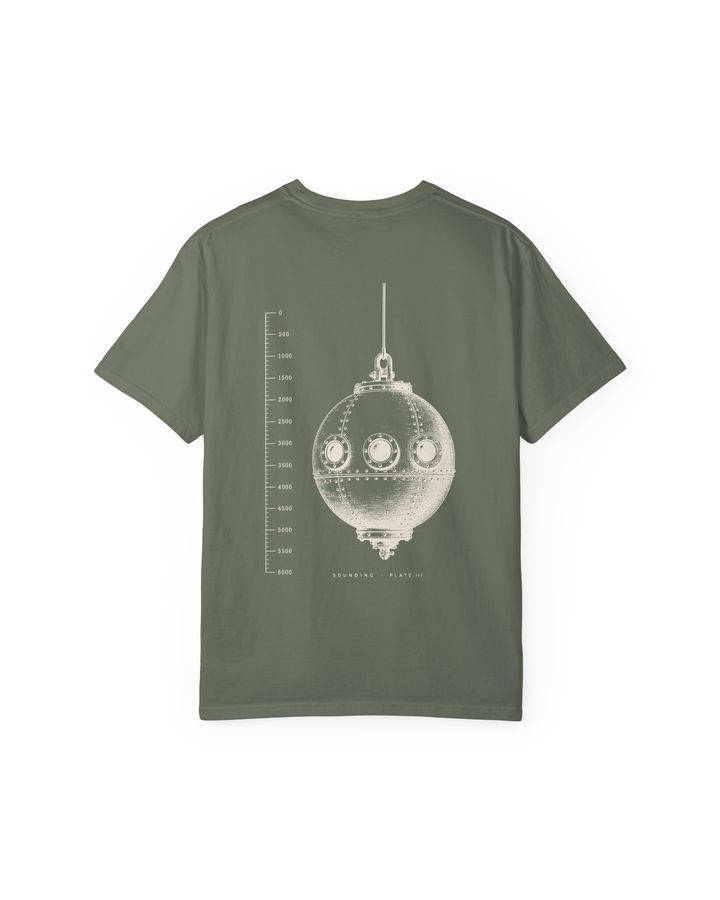
The plate
Sounding
A riveted bathysphere on a single cable, with the depth scale that mattered more than the vessel.
See the plate — $48