The pen that does not move
A seismograph does not record the earthquake. It records the difference between a mass that stays still and a planet that does not.
The steady point
Everything in a seismograph is bolted to the ground except one thing. The frame moves because the planet moves. The suspended mass tries not to. What the instrument draws is the gap between them — not the earthquake, but the disagreement between a mass and its own frame about whether anything happened.
John Milne, who spent the 1880s in Japan turning a curiosity into a discipline, put the whole problem in one sentence in 1886: “To obtain an absolutely ‘steady point’ at the time of an earthquake, has been one of the chief aims of all recent seismological investigations.” He then divided every instrument ever built into two families — “those which at the time of the shock are intended to swing, and thus record the direction of movement; and second, those which are supposed to remain at rest and thus provide ‘steady points.’” The second family won.
There is no such thing as a mass that ignores the ground. A suspension always has a restoring force, and a restoring force means a natural period. Below that period the mass follows the frame and records nothing. Worse, the sensitivity to slow ground motion falls off as the square of the free period. The entire history of the instrument is an argument about how to make that period long.
The hundred-metre pendulum
A simple pendulum one metre long swings with a period of nearly two seconds. To get twenty seconds you need one a hundred metres long. That is not a design, it is a building.
So the instrument cheats gravity instead of fighting it. In a horizontal pendulum — the Zöllner or “garden gate” suspension — the mass swings in a nearly horizontal plane about a nearly vertical axis. Tilt the axis by a fraction of a degree and only that fraction of gravity acts as a restoring force. A garden-gate pendulum with a twenty-second period can be thirty centimetres long if its axis is tilted about 0.2° from vertical.
The price is exactly what you would expect. As the tilt shrinks the period lengthens, and the instrument becomes less and less able to tell an earthquake from the floor settling underneath it. Erhard Wielandt states it plainly in the standard manual: the longer the period is made, the less stable the instrument will be under small tilt changes. The vertical component has the same problem in a different geometry — Lucien LaCoste solved it in 1934 with a spring pre-stressed to zero length, which yields an infinite period only if three conditions hold simultaneously, and which is, in Wielandt’s words, difficult to operate without a stabilising feedback system.
That clause is the hinge of the whole story. Written in a chapter about mechanical suspensions, it is a promissory note on the machine that replaced them.
A gram of copper and two drops of oil
The Wood–Anderson torsion seismometer, built at Caltech in the 1920s, is the most consequential instrument in the field and it is almost nothing. A tungsten wire about sixteen centimetres long and one-fiftieth of a millimetre thick. A copper cylinder two and a half centimetres long and two millimetres across, hung off its axis with a mirror attached. The entire moving assembly weighs about 0.7 gram. The restoring force is not gravity at all — it is the torsion of the wire.
It sat in the field of a permanent magnet, so the copper damped itself by eddy currents; that is what J. A. Anderson’s 1924 patent claims. But a taut wire under tension also wants to sing, and the fix for that was two small drops of castor oil with the wire passing through them, which the Saint Louis University description says “almost completely eliminates the undesirable ‘violin string’ vibration.”
An undamped seismograph is useless: it rings at its own period and buries the signal under its own reply. The theoretical optimum is a damping ratio of 1/√2, about 0.707, which gives a maximally flat passband — a second-order Butterworth response. At that value a free swing decays to 4.3% of its amplitude within a single half-wave.
The scale is defined by the instrument, so the instrument’s errors are inside the scale
Charles Richter’s 1935 paper defines magnitude in terms of one specific machine: “the logarithm of the maximum trace amplitude, expressed in microns, with which the standard short-period torsion seismometer (T₀ = 0.8 sec., V = 2800, h = 0.8) would register that shock at an epicentral distance of 100 kilometers.” Magnitude zero is one micron of trace at 100 km. The familiar version — one millimetre at 100 km is magnitude 3 — follows correctly, since a millimetre is a thousand microns, but it is not what Richter wrote.
He knew what he had made and said so on the same page: “This definition is in part arbitrary; an absolute scale, in which the numbers referred directly to shock energy or intensity measured in physical units, would be preferable.” A footnote heads off the obvious misreading — zero on the scale does not mean no shock; zero is the logarithm of one.
Then in 1990 Uhrhammer and Collins measured four real Wood–Anderson instruments and got a static magnification of 2080 ± 60, not the 2800 everyone had been quoting. They traced it to an assumption in the original design paper: the torsion suspension was taken to be distortion-free, when in fact the asymmetric mass can deviate far enough from the rotation axis to roughly double the moment of inertia. They measured damping near 0.70 rather than the specified 0.8 — and their own paper prints that figure twice, once as 0.69 ± 0.023 and once as 0.70 ± 0.023.
None of this changed a single published magnitude, because the scale is defined by the instrument and not by the number. It matters only when you synthesise a Wood–Anderson record from a modern digital one, where using 2800 overestimates local magnitude by about 0.13 units. And there is a blunt physical ceiling underneath all of it: Wood–Anderson trace amplitudes are limited to roughly 140 mm by the aperture of the drum lens. Part of the reason the scale saturates above magnitude 6 or so is that the photographic drum ran out of room.
The instrument that holds the mass still
A modern broadband seismometer inverts the problem. Instead of letting the mass swing and measuring where it went, it generates an electrical force that pushes the mass back so that it follows the frame almost exactly — some small relative motion must remain, or there would be nothing to detect at all. The output is the feedback current: the force required to prevent the motion.
Wielandt names the payoff directly. Because the current, the voltage across the feedback resistor and the output voltage are all proportional to ground acceleration, “we have converted the acceleration into an electric signal without depending on the precision of a mechanical suspension.” After sixty years of trying to build a mass that ignores the ground, the field stopped trying and built a servo that lies to it.
The numbers moved accordingly. A Nanometrics Trillium Horizon 120 is a 170 mm cylinder drawing 230 milliwatts, specified with −3 dB points at 120 seconds and 150 Hz and 168 dB of dynamic range at 1 Hz. Streckeisen quotes 145 dB for the STS-2. Those two figures are not comparable as printed — different instruments, different reference conditions — which is why the honest thing is to quote both with their conditions attached rather than average them into a sentence about modern instruments in general.
The design goal of the Global Seismographic Network states the ambition without adjectives: resolve at or near ambient noise, from free oscillations at 10⁻⁴ Hz up to teleseismic body waves near 15 Hz, and stay on scale for earthquakes as large as magnitude 9.5. One instrument, from the ringing of the entire planet down to a distant tremor, without clipping.
Milne’s steady point was never achieved. It was made unnecessary.
Sources
- Wielandt, “Seismic Sensors and their Calibration”, NMSOP-2 Chapter 5 — GFZ Potsdam
- Richter (1935), “An Instrumental Earthquake Magnitude Scale”, BSSA 25(1) — CaltechAUTHORS
- Uhrhammer & Collins (1990), “Synthesis of Wood-Anderson Seismograms from Broadband Digital Records” — NCEDC
- John Milne, “Earthquakes and Other Earth Movements” (1886) — Project Gutenberg
- The Torsion Seismometer — Saint Louis University Earthquake Center
- Anderson, “Seismometer”, US Patent 1,552,186 (1925) — Google Patents
- Earthquake Magnitude, Energy Release, and Shaking Intensity — U.S. Geological Survey
- Trillium Horizon 120 datasheet — Nanometrics
- GSN Design Goals (2002) — EarthScope
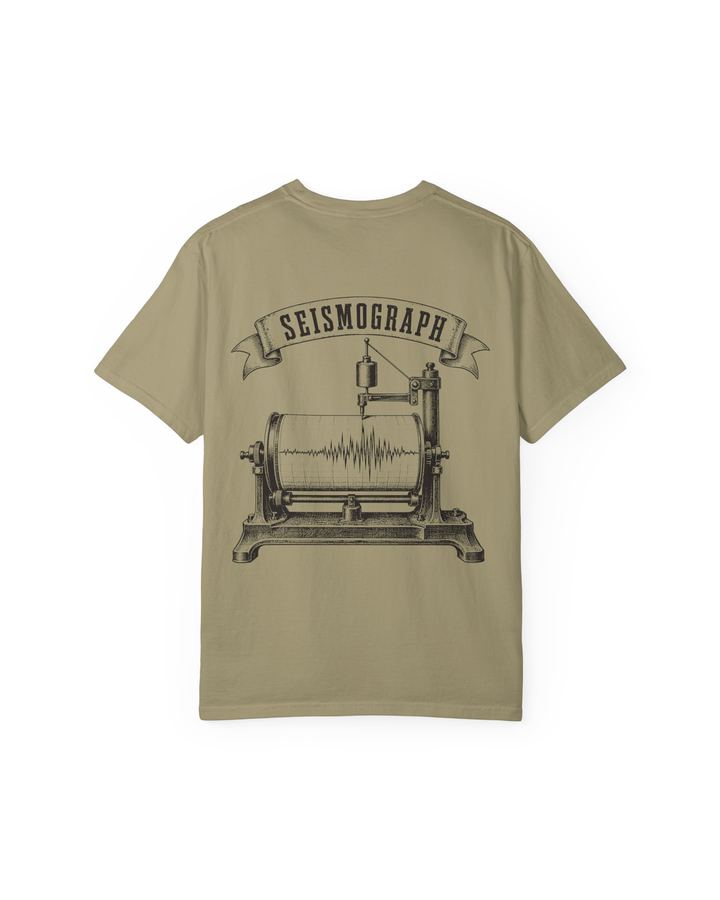
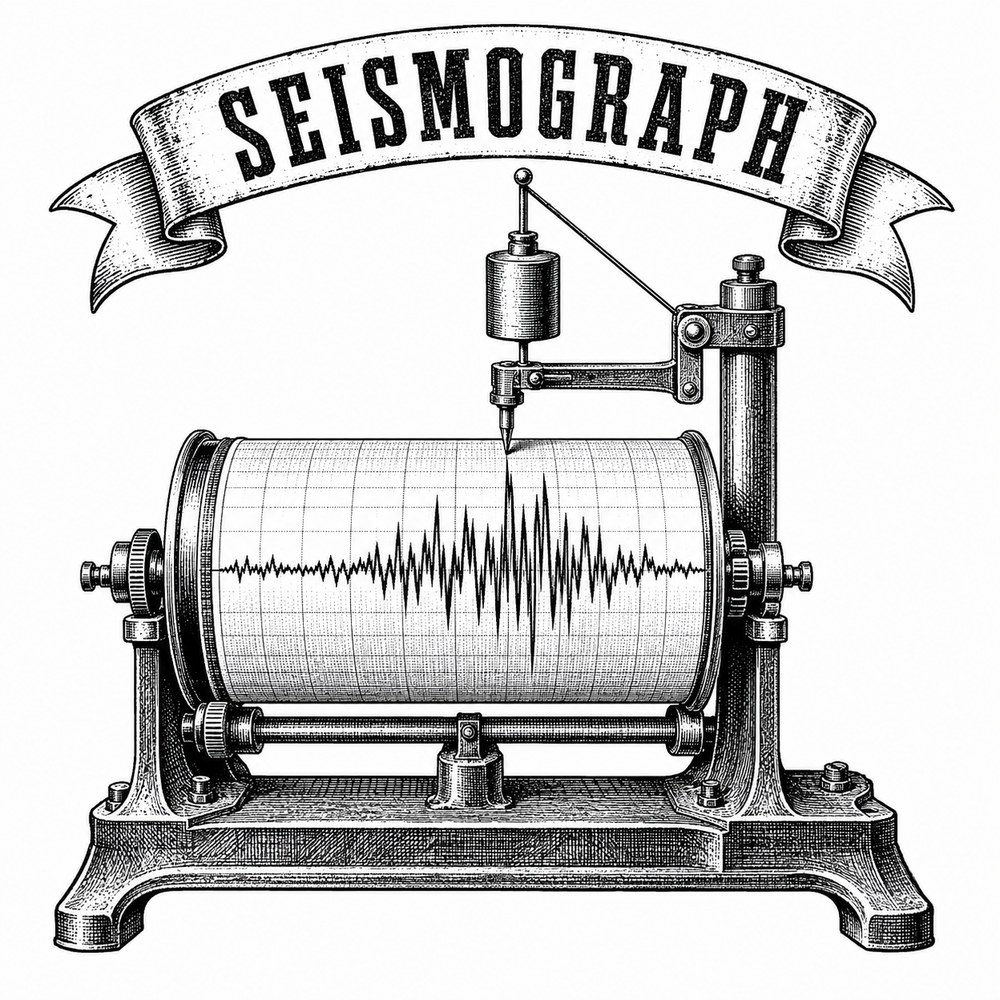
The plate
Seismograph
A drum, a weighted pendulum, a stylus that does not move — and a line that records everything that does.
See the plate — $48