The instrument the forecast is built on
Twice a day, on the same two hours worldwide, hundreds of balloons carry a small box to the edge of the stratosphere. Almost none of them come back.
Two hours the whole world agrees on
Numerical weather prediction begins with a state of the atmosphere, and a state has to be taken everywhere at once. That is the entire reason the upper-air network exists: not to measure the weather at a station, but to measure the weather at every station simultaneously, so that a model has something coherent to start from.
The agreed hours are 0000 and 1200 UTC, with a second tier at 0600 and 1800. The World Meteorological Organization describes a global network of about a thousand upper-air stations, of which over two-thirds observe at both 00 and 12 UTC. The US National Weather Service runs 92 of them — 69 in the lower 48, 13 in Alaska, 9 in the Pacific, 1 in Puerto Rico — and supports ten more in the Caribbean.
The simultaneity is a designed fiction, and the manual is candid about it. Balloons go up an hour before the hour they are named for: “Release times should be scheduled as close as conditions permit to 2300 UTC and 1100 UTC, but not earlier.” The window for a 1200 UTC observation opens at 1100 and closes at 1229; after that it is a missed sounding. The instrument needs an hour of climbing to reach altitude, so the world’s midday snapshot is assembled from a thousand instruments released at eleven and drifting apart ever since.
It is worth noting that the three official sources do not agree on how many stations there are. WMO says about a thousand; the NWS fact sheet says over 800; an NWS field-office poster says almost 900. Nobody publishes a global soundings-per-day figure at all. What you can say precisely is the station count you cite and who said it.
What is actually in the box
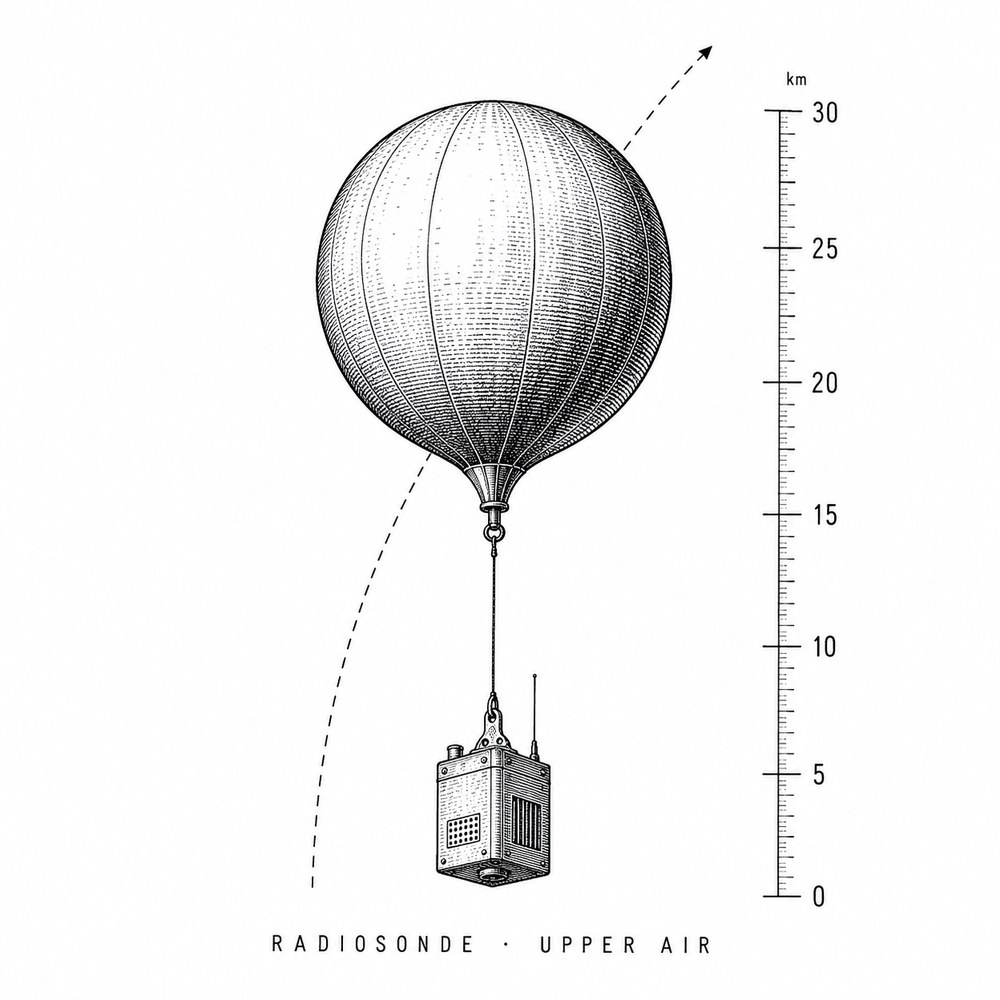
Sixty to eighty grams. A Vaisala RS41-SG is 155 by 63 by 46 millimetres and weighs 80 grams with its foam cover; a Graw DFM-17 weighs 63. Two AA lithium cells give more than four hours. It transmits once a second in the 400–406 MHz band at around 60 to 100 milliwatts, which is less power than a phone charger wastes as heat.
The sensors are worth being precise about, because the usual summary is wrong on the most basic one. Temperature on the RS41 is a platinum resistor — resolution 0.01 °C, response half a second, rated to −90 °C. Humidity is a thin-film capacitor, and it is heated: the heating element exists so the sensor can de-ice itself while climbing through freezing cloud, and the instrument reconditions the sensor before launch to drive off chemical contaminants.
Pressure is the surprise. Both the Vaisala RS41-SG and the Graw DFM-17 list pressure as calculated from GNSS position, not measured — the same satellite fix that gives wind by tracking the balloon’s drift also gives geopotential height, and pressure falls out of that. WMO and the NWS fact sheet still describe radiosondes as measuring pressure, and for older hardware, and for the barometer-equipped RS41-SGP variant, they are right. For the commonest sondes flying today they are describing a derived quantity.
Winds were not always satellite-derived. The NWS still runs two frequency bands in parallel — 1680 MHz and 403 MHz — precisely because the higher band supports radio direction-finding for winds, which is cheaper than putting GPS in something you intend to lose.
A balloon that ends up thinner than cling film
The balloon leaves the ground about a metre and a half across, made of thin-skinned latex with a wall between 0.051 and 0.102 millimetres thick. It climbs at 275 to 350 metres per minute — roughly five metres a second — and as the surrounding pressure falls, it inflates.
By burst, the operations manual says, it reaches a diameter of up to ten metres with a wall thickness of 0.0025 millimetres. The latex thins by a factor of twenty to forty and ends up thinner than kitchen film. The public fact sheet from the same agency says it bursts at six to eight metres, so the expansion is somewhere between four and seven times in diameter — a hundred to three hundred times in volume — depending which NOAA document you are holding.
Along the way it passes through temperatures as cold as −90 °C and winds over 400 km/h, exceeds 35 km of altitude, stays up more than two hours, and drifts. The fact sheet says more than 300 km; other NWS pages say 200 km, or 100 miles. Then the balloon fails, a small orange parachute opens, and the instrument comes down somewhere nobody chose.
One documented flight, because a real one is worth more than a range. Key West, 17 March 2020, released at 7:05 pm. Burst at 8:46 pm at 33.16 km. Lowest pressure 7.27 millibars, coldest temperature −76.8 °C, strongest wind 71 mph, 101 minutes aloft, 12,161 data points, and a landing 44.7 km away — which, from Key West, means the sea.
Designed to be lost
The NWS releases approximately 75,000 radiosondes a year and about 20% are found and returned for reconditioning. The rest stay where they fell. Each release costs roughly $200.
What is quietly remarkable is that the return path is built into the instrument’s own structure: “If you found a radiosonde, please follow the instructions on the mailing bag that can be found inside of the plastic antenna.” A prepaid bag, folded inside the antenna, on an object thrown into the stratosphere twice a day from ninety-two sites. It works one time in five, and one time in five is apparently worth designing for.
That the network is expendable is not a flaw in it. It is what makes the vertical resolution possible. The NWS puts the case in a single sentence: “No single observing system (e.g., satellites, aircraft, or ground-based sensors) can match the vertical data resolution (about 5 meters) and height coverage obtained with radiosondes.” Five metres, from the ground to the stratosphere, on a $200 instrument you are never going to see again.
Why it survives the satellite era
The obvious question is why anyone still throws hardware into the sky when satellites watch the whole atmosphere continuously. ECMWF has measured it: satellites supplied about 74% of total observation impact in 2019 and surface-based observations 26% — yet surface-based data remained more important than the single most impactful satellite data type, microwave radiances, in the northern hemisphere, especially for short-range forecasts.
And the value is not spread evenly. ECMWF’s analysis of forecast sensitivity found that isolated stations contribute far more to reducing forecast error than any one station in a well-observed region. A single sounding over an ocean, a desert or a polar plateau outweighs any individual European site. The network is worth most exactly where it is thinnest.
The origin is genuinely contested and it is better to say so than to pick. Robert Bureau in France flew a device on 7 January 1929 and gave it the name radiosonde; the anniversary is observed as Radiosonde Day, and the Smithsonian history dates the invention to 1929. Pavel Molchanov in the USSR flew his in 1930, and it is his that is usually called the first practical one — its output was Morse-coded, so it needed no special ground equipment, which is why it spread. The first successful US flight came on 23 December 1935 from Blue Hill Observatory, reaching 52,500 feet.
First flown and first adopted are different achievements. Almost a century later, the thing itself has barely changed shape: a small box, a rubber balloon, a radio, and a decision to let it go.
Sources
- Radiosonde Observations, NWS Manual 10-1402 (8 December 2023) — NOAA / National Weather Service
- Radiosonde Observation Fact Sheet — NOAA / National Weather Service
- Weather Balloons fact sheet — NWS Key West, Office of Observations
- Weather Balloons poster, with the 17 March 2020 flight record — NWS Florida Keys
- Weather Balloon Tour — NWS Reno
- Global Observing System (GOS) — World Meteorological Organization
- Radiosonde RS41-SG datasheet (B211321EN-H) — Vaisala
- Radiosonde DFM-17 — Graw Radiosondes
- The importance of additional surface-based observations in data-sparse regions — ECMWF
- What is a Radiosonde? — Radiosonde Museum of North America
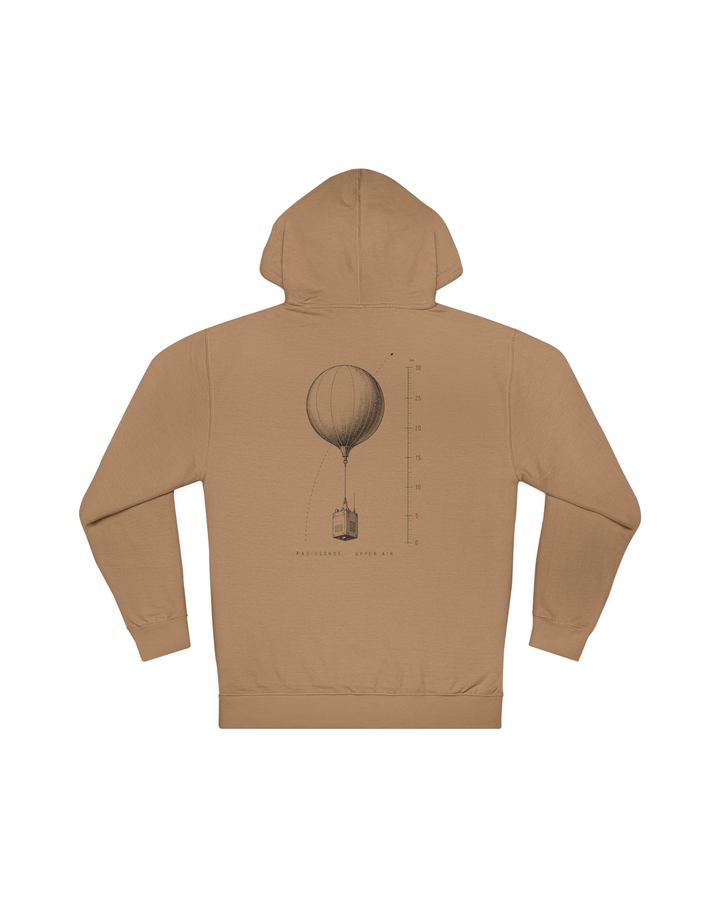
The plate
Radiosonde
A balloon, a small instrument box, and thirty kilometres of vertical column measured on the way up.
See the plate — $98