Air that nobody has breathed
An ice core is a column of old atmosphere held in bubbles. Why the gas in the bubble is younger than the ice around it, and what that costs to measure.
The bubble is younger than the ice around it
The appeal of an ice core is easy to state: snow falls, does not melt, and buries the snow beneath it, so a column of polar ice is a stack of years with samples of the atmosphere sealed inside. Drill down far enough and you can open a bubble of air that last touched the sky before there were cities.
The complication is that the seal does not happen at the surface. Fresh snow is mostly air, and it stays connected to the atmosphere as it compacts. The layer where this is happening — firn — is permeable, sometimes for a century of accumulation, and the air in its pore space keeps exchanging with the air above it. Only when the density rises far enough do the passages pinch shut and the pores become bubbles.
Parrenin and colleagues put it plainly: gas bubbles “are always younger than the surrounding ice because they close off and trap the air at 50–120 m … below the surface, after the snow has densified into ice.” The exact depth depends on the site. At close-off, roughly 37 per cent of the pore volume has been sealed.
So every ice core carries two clocks that do not agree. The ice at a given depth has one age. The air inside it has another, younger one. Nothing about the physical sample tells you the difference — it has to be modelled or measured independently, and getting it wrong quietly corrupts everything downstream.
What the disagreement costs
The offset has a name — Δage — and its size varies enormously with where you drill. The controlling variable is how fast snow accumulates: pile it on quickly and the firn is buried and sealed in a few decades; pile it on slowly and the air stays connected to the sky for millennia.
At Law Dome in East Antarctica, where accumulation is high, the DE08 site seals at 72 metres and the ice there is 40 ± 1 years old when it does. At the other end, the modelled Δage at EPICA Dome C spans something like 1,000 to 12,000 years across the plausible range of past temperature and accumulation. At WAIS Divide, the largest Δage in the record occurs at the Last Glacial Maximum: 525 ± 120 years.
This is not bookkeeping. One of the most litigated numbers in climate science is the lag between Antarctic temperature and atmospheric CO₂ across a deglaciation — reported as 800 ± 600 years by Monnin and colleagues, 800 ± 200 for Termination III by Caillon, 600 ± 400 averaged over three deglaciations by Fischer. Every one of those figures is a difference between an ice clock and a gas clock. The uncertainty in the lag is, in large part, the uncertainty in Δage.
Which is why so much effort goes into pinning the two clocks together independently — synchronising a methane record to a Greenland core, or a beryllium-10 spike from a known geomagnetic event. At Dome C the Laschamp event gives a Δdepth of 48.9 ± 2 metres at a depth of 782.9 metres. That is a hard measurement of the offset rather than a model of it, and hard measurements of Δage are rare enough to be worth a paper each.
Down to the bed, and the compression at the bottom
The deep cores are a short list. Vostok reached 3,623 metres in January 1998 and about 420,000 years, and stopped deliberately above the subglacial lake beneath it rather than risk contaminating it. GISP2 in Greenland went to 3,053.44 metres, 1.55 metres of that into bedrock. WAIS Divide reached 3,405 metres. EPICA Dome C reached about 3,270 metres and 800,000 years across eight glacial cycles — though the project’s own figures put the final depth at 3,270.2 m in one account and around 3,260 m in another, and bedrock was not reached either way.
Those holes do not stay open on their own. At depth the ice deforms and closes the borehole, so deep drilling is done wet, with the hole filled by a fluid — n-butyl acetate at GISP2, an Isopar K and HCFC-141b mixture at WAIS Divide, and more recently ester and hydrocarbon blends chosen for lower toxicity.
The real difficulty at the bottom is not the drilling. It is that ice flows, and flow thins the layers. Near the surface an annual layer is a visible band; at WAIS Divide the upper 2,850 metres — 31,200 years — are dated by counting them one at a time. Go deeper and they compress past any hope of counting. At the base of the Little Dome C core, the Beyond EPICA team report that up to 13,000 years are compressed into a single metre of ice. That is something like eight hundredths of a millimetre per year.
It follows that the oldest ice is not merely the hardest to reach. It is the ice where a centimetre of sampling error costs a century, and where the layers you would use to check your chronology no longer exist as layers.
The oldest ice, and what the record actually says
In the 2024/25 season the Beyond EPICA project drilled to bedrock at Little Dome C, 2,800 metres down, after more than 200 days of drilling across four campaigns at 3,200 metres above sea level, where the average summer temperature is around −35 °C. The recovered core is shipped and stored on a −50 °C cold chain.
The result is worth stating precisely, because it is routinely overstated. The uppermost 2,480 metres contain a climate record reaching about 1.2 million years, with the 0.8-to-1.2-million-year interval sitting between 2,426 and 2,490 metres — as the field team noted, “exactly where it was predicted to be”. The project’s frequently quoted 1.5-million-year figure is its original target, not its result; the official statements say at least 1.2 million years and probably beyond.
And the lowest 210 metres above the bed are heavily deformed, possibly mixed or refrozen, of uncertain origin. They are ice, and they are old, but they are not a climate record. A fifth campaign began in November 2025 to recover duplicate ice between 2,350 and 2,590 metres and drill into the bedrock itself.
Measuring air you are not allowed to contaminate
Getting the gas out without changing it is its own discipline. Melting the ice lets carbon dioxide dissolve into the meltwater, so the precise work is done dry: the sample is crushed or milled under vacuum at around −35 °C and the released air is collected. The Law Dome measurements, made with a dry extraction technique its authors nicknamed the cheese grater, are quoted at a precision of 0.2 ppm. Tschumi and Stauffer verified their own reproducibility at better than 1.3 ppmv by adding known CO₂ standards to artificial gas-free ice and crushing them as ordinary samples.
Then there is the finding that quietly halved the useful map. Carbon dioxide cannot be reliably measured in Greenland ice at all. Greenland records run about 20 ppmv above Antarctic ones at the same age — far beyond any plausible difference between hemispheres — and across the abrupt Dansgaard–Oeschger events they show interstadial values 50 to 90 ppmv above stadials while Antarctic cores show no such swing. Most damningly, Greenland CO₂ can vary by 60 ppmv or more within one or a few annual layers, which no atmosphere does.
The cause is that the ice is dirty. Greenland receives far more continental dust; acids in the ice react with carbonate particles, and organic material oxidises, and both processes make carbon dioxide inside the sample. Tschumi and Stauffer concluded that the organic oxidation is at least as important as the acid–carbonate reaction. Antarctic ice works because it is cleaner, with fewer impurities and therefore fewer ways for the sample to manufacture the gas you came to measure.
What survives all of that is a number like this one: 171.6 ± 1.4 parts per million, measured at 3,062 metres in the Dome C core, the lowest carbon dioxide concentration in the 800,000-year record. Which is a strange object to hold. It is a measurement of the whole planet’s atmosphere, taken from a cylinder of ice the width of a forearm, of air that was last outdoors before our species existed.
Sources
- Parrenin et al. (2012), “On the gas-ice depth difference (Δdepth) along the EPICA Dome C ice core” — Climate of the Past 8:1239
- Buizert et al. (2015), “The WAIS Divide deep ice core WD2014 chronology, Part 1” — Climate of the Past 11:153
- Tschumi & Stauffer (2000), “Reconstructing past atmospheric CO₂ concentration based on ice-core analyses” — Journal of Glaciology 46(152)
- EPICA community members (2004), “Eight glacial cycles from an Antarctic ice core” — Nature 429:623
- Beyond EPICA reaches bedrock at Little Dome C — project press release, January 2025
- Uncovering Earth’s Oldest Ice: the final Antarctic campaign — CNR, 26 November 2025
- GISP2 core inventory — NSF Ice Core Facility
- WAIS Divide core inventory — NSF Ice Core Facility
- Vostok ice core, project information — NOAA Paleoclimatology
- Law Dome CO₂ record, Etheridge et al. — NOAA Paleoclimatology
- Lüthi et al. (2008), “High-resolution carbon dioxide concentration record 650,000–800,000 years before present” — Nature
- Bereiter et al. (2015), “Revision of the EPICA Dome C CO₂ record from 800 to 600 kyr before present” — Geophysical Research Letters
The plate
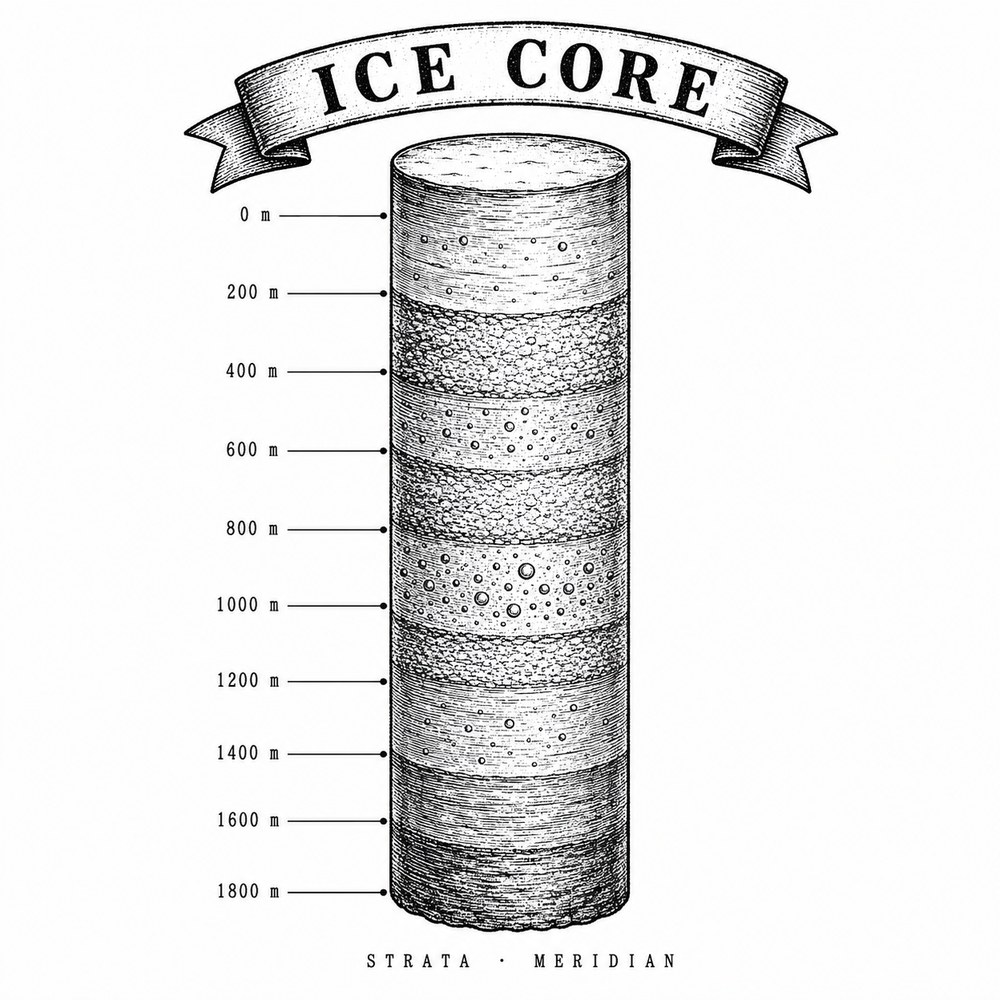
Ice Core
A cylinder of compressed snow, banded like tree rings, holding air that has not been breathed since the Bronze Age.
See the plate — $98