Star maps / Sky on any date
Free star map generator for any date and place
Type a date and a place. You get the star map of that night, drawn by the code that prints our posters, plus where the moon stood, which planets were out and when the sun went down. Free, with no sign-up.
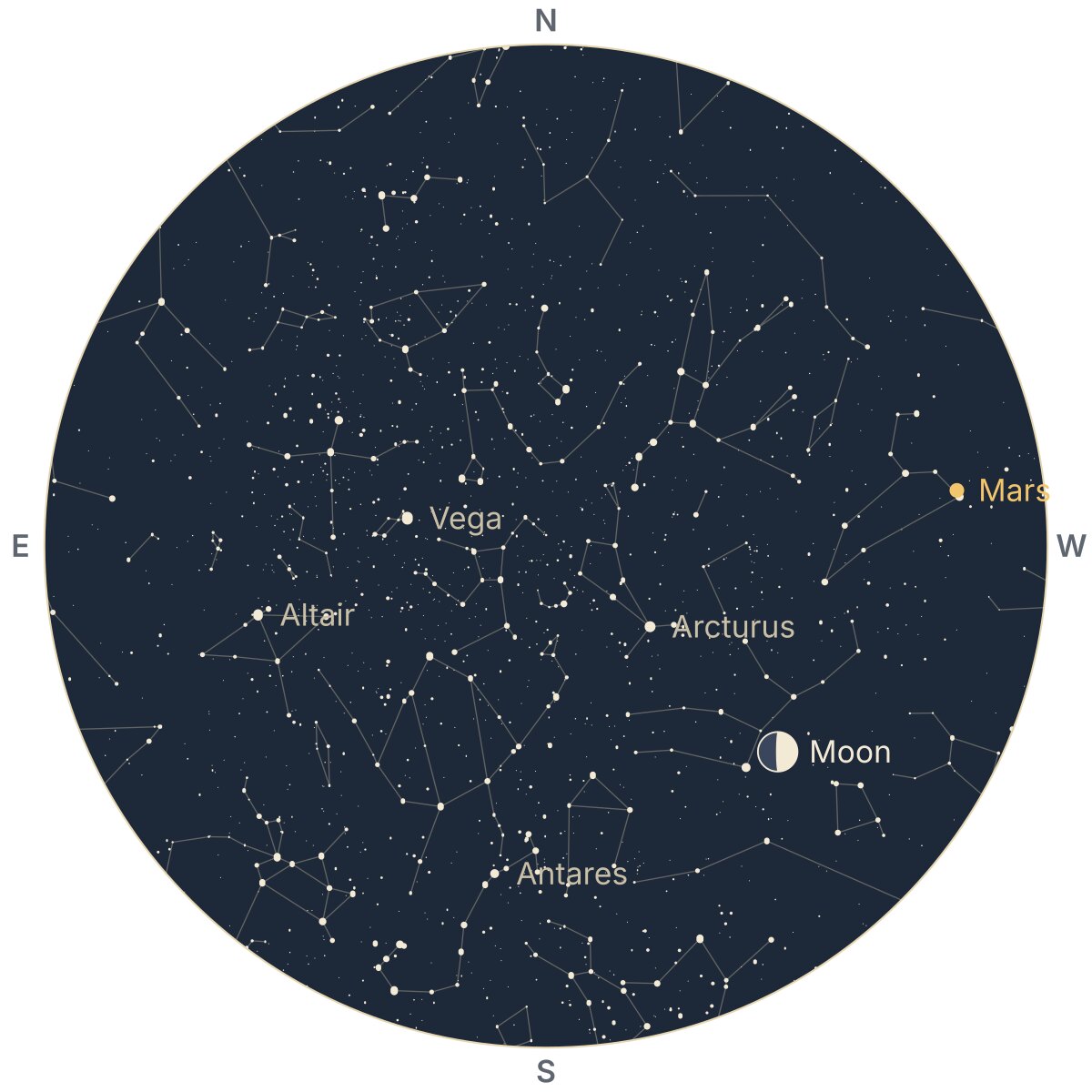
The sky over Philadelphia, PA on Sunday, July 4, 1976
- The hour9:00 pm local sun time, when clocks there read 10:00 pm EDT.
- The sunTwilight, with the sun 13° below the horizon. It had set at 8:32 pm EDT, and full dark came at 10:33 pm. Next morning it rose at 5:37 am.
- The moonFirst quarter moon, 54% lit, 27° up in the southwest in Virgo. It rose at 1:17 pm and set at 12:44 am.
- The planetsMars 11° up in the west in Leo. Mercury, Venus, Jupiter and Saturn were below the horizon.
- The brightest stars upArcturus in Bootes, 61° up in the southwest; Vega in Lyra, 59° up in the east; Altair in Aquila, 29° up in the east; Spica in Virgo, 29° up in the southwest; Antares in Scorpius, 23° up in the south.
- OverheadStraight above was Hercules. Also high up: Ursa Major, Ophiuchus, Cygnus, Draco and Bootes.
- On a Meridian posterOur "Our star" design circles the brightest named star at least 45° up. For this night that is Arcturus.
The poster opens in our editor with this date and place filled in. You see it before you pay. Print from $39.
How to make your star map
- Pick the date.Any day from 1900 to 2100: a birth, a first date, a wedding, a night that is still ahead.
- Type the place.A town, a street address or a park, then choose it from the list.
- Choose the hour.9 pm is what our posters print. Pick a later hour if the night ran late; the chart turns with the sky.
- Show the sky.The map draws in a second or two, with the night written out under it. Copy the link to keep it or send it.
How it works
The star chart is the same one we print on our star map posters. It holds 4,086 stars, every one bright enough to see from a dark spot with no telescope, from the Yale Bright Star Catalog, with the constellation lines drawn between them. We turn that sky for your date, your hour and the exact spot on Earth, then draw what was above the horizon. We checked those star positions against astronomy-engine for six nights from 1900 to 2100; the numbers are on are star maps accurate?
The moon, the planets, sunset and full dark come from astronomy-engine, an open source library by Don Cross that is tested against NASA JPL data. The moon phase is the share of the disc that was lit. Planets are listed when they stood more than 3 degrees above the horizon. Mercury, Venus, Mars, Jupiter and Saturn are the five you can see by eye.
Hours are local sun time, the way our posters work: 9 pm means the sun was as far past noon as it is at 9 on a clock that runs on the sun at that spot. For most US places and many countries we also show what the clocks read, daylight saving included. Where a state is split between two time zones and the spot sits near the line, we show sun time only and say so.
From the free star map to a printed poster
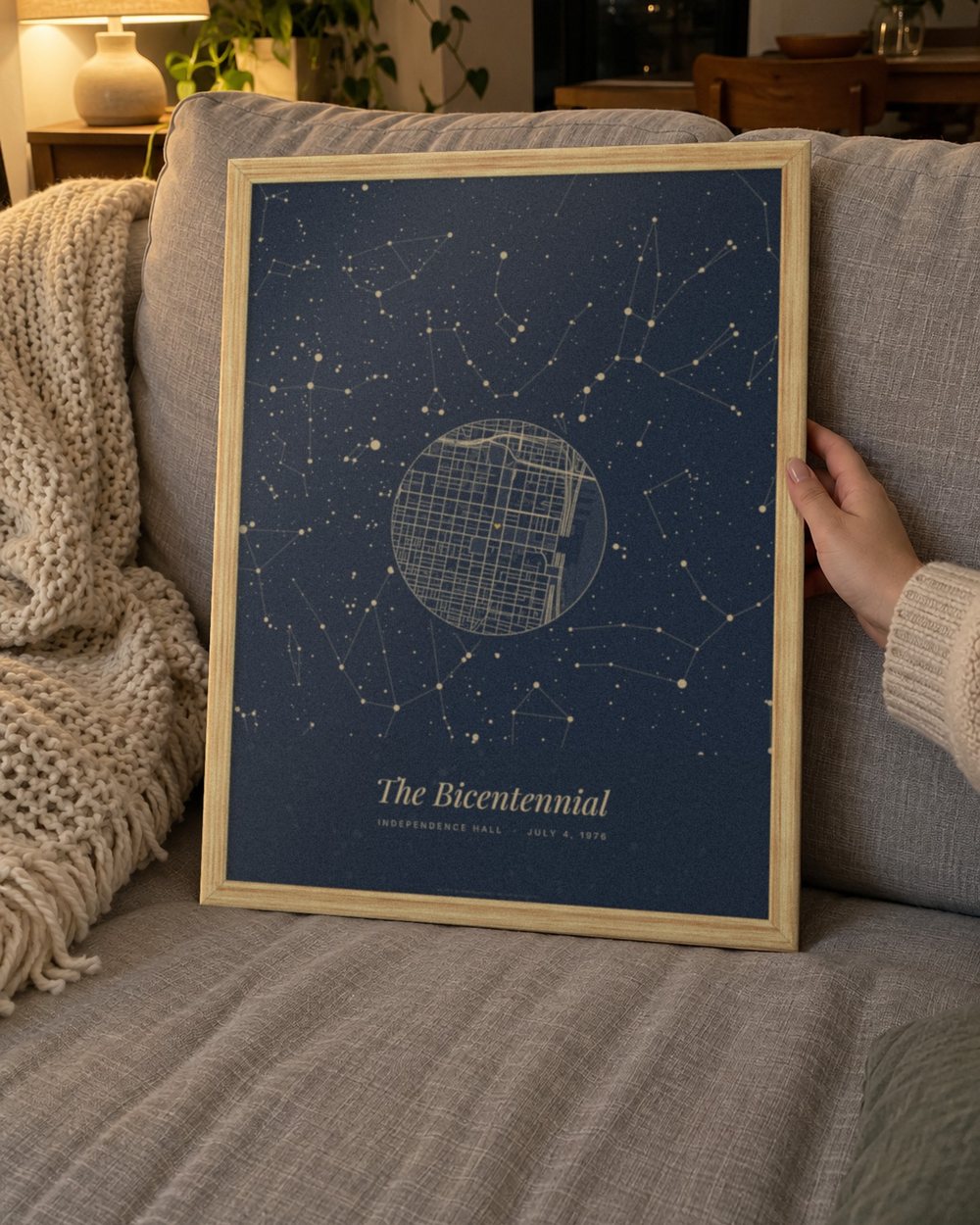
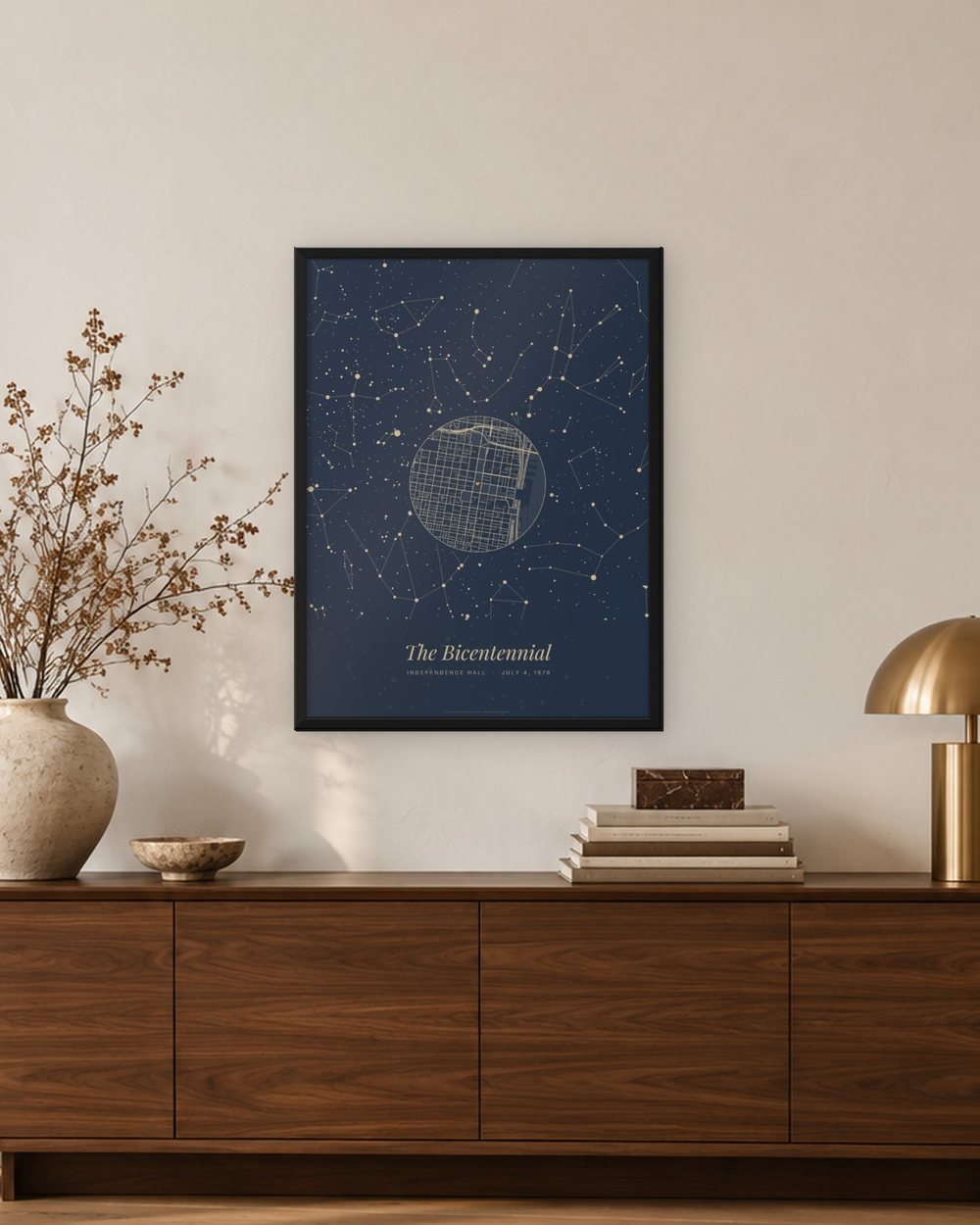
The chart on this page is free and stays free. When one night is worth keeping, we print it. Above is the example night as our poster in The whole night design, with “The Bicentennial” where couples usually put their names.
The poster is drawn from the same stars as the chart, so the patterns match. A few things differ, and it helps to know them before you order:
| Free star map here | Printed poster | |
|---|---|---|
| Hour | 6 pm to 5 am, your pick | Always 9 pm local sun time |
| Dates | 1900 to 2100 | 1930 to this year, in the editor |
| Sky shown | All of it, down to the horizon | All of it on Our star; about 60 percent on Under the stars and about half on The whole night, where a street map of the place takes the rest |
| Moon and planets | Drawn and written out | Not printed |
| Words | The place and the date | Your names or your own line, the place and the date |
| Made of | Your screen and a link | 230 gsm acid free matte paper, pigment inks; 3 sizes, print only or in one of 8 frames |
| Cost | Free | Print from $39, framed from $89 |
Share of sky measured for one night on are star maps accurate? Delivery in the US takes 4 to 8 business days, and US shipping is free.
Ran the chart for your own night already? The Print button under your result carries it straight into the editor, so your poster is ready to check before you order.
Three nights, worked out
Open any of these to see the full chart. The numbers below come from the same page.
July 20, 1969, Houston
The evening of the first Moon landing.
At 9 pm sun time the moon was a waxing crescent, 36 percent lit, 18 degrees up in the west, and set just before midnight. Jupiter shone 16 degrees up in the west and Mars sat in Scorpius, 35 degrees up in the south.
December 31, 1999, Times Square
Midnight into the year 2000.
At midnight sun time the clocks read 11:55 pm. Orion stood high in the south with Betelgeuse 55 degrees up, Capella was 74 degrees up in the northwest, and Jupiter and Saturn were both up in the west. The moon had not risen yet.
August 21, 2017, Nashville
The evening of the total solar eclipse.
A new moon, which is what made the eclipse possible that afternoon, so the night was moonless. Vega was almost straight overhead at 84 degrees and Saturn sat 27 degrees up in the southwest.
Nights people look up
Most people come here with one date in mind. The night they were born, the night they met someone, a wedding, the night a parent or grandparent was born. If that night means something to you, it can hang on a wall: our star map posters print the same sky, with the names, the place and the date beneath.
Questions
Can I see the sky the night I was born?
Yes. Type your birth date and the town or hospital, then pick the hour if you know it. Born in the afternoon? The page shows night skies only, so 6 pm is the earliest hour, and that is the sky that came out over you a few hours later.
What is local sun time?
The time set by the sun at that spot, so noon is when the sun is highest. Clocks follow time zones and daylight saving, which can put them an hour or more away from it. Where we know the time zone, the result gives the clock time too.
How far back does it go?
From January 1, 1900 to December 31, 2100. The stars barely move in a lifetime, but the moon and the planets change every night, and those are worked out for the exact date.
How accurate is it?
Closer than you can see by eye. The moon and planets are worked out for the exact minute. Sunrise and sunset assume a flat horizon, so hills or tall buildings can move them by a few minutes. The star chart keeps star positions as of the year 2000, which for a date around 1900 shifts the whole pattern by about a degree.
Is the moon on your star map posters?
No. The poster prints the stars, the constellation lines and one named star for your place and date. The moon and planets are shown on this page only.
Is this star map generator free?
Yes. Making a star map here costs nothing, and there is no account, no email and no limit on how many nights you look up. You pay only if you order a printed poster of a night.
Can I download the star map?
There is no download button. Each night has its own link, so you can copy it, send it or open it again later. To get the night on paper, the Print button under the result opens it as a poster in our editor with the date and place filled in, and you see the poster before you pay.
Why does the poster show 9 pm when I picked another hour?
Every poster we print shows the sky at 9 pm local sun time for the date and place you type. The hours on this page are there so you can see the sky later that night. From 9 pm to midnight the stars turn about 45 degrees, so a later chart looks different from the poster.
Do I need an account?
No. There is no sign-up and no email. Each night gets its own link that you can copy and send.